Grandma's Living Room Is Having a Moment: How Indian Design Took Over the American Home
There's a particular kind of vertigo that hits when you scroll through an Anthropologie catalog and spot a hand-blocked indigo textile that looks exactly like the bedspread your nani brought over in a suitcase from Jaipur in 1987. Or when a home décor influencer with 800,000 followers calls her living room "globally inspired" — and it's basically a recreation of every South Asian auntie's front room, minus the plastic-covered sofa.
Welcome to 2025, where Indian design has officially gone mainstream. And desi America has a lot of feelings about it.
The Aesthetic Has Always Been There
For anyone who grew up in a South Asian household in the US, the visual language of Indian interiors was simply... home. The brass urlis filled with marigolds. The heavy silk curtains in jewel tones. The intricate carved wooden furniture that took up too much space in a suburban ranch house but anchored the room in something ancient and intentional. The small bronze Ganesh on the mantle next to a framed photo of a relative who never made it to America.
None of this was called "maximalist" or "eclectic" or "artisanal." It was just how your parents decorated. Sometimes it was a source of embarrassment during sleepovers. Sometimes it was a source of pride. Mostly it was just the wallpaper of your childhood.
Fast forward to now, and every major trend report in the American interior design industry is falling over itself to describe what they're calling the "New Global Maximalism" — a rejection of the cold, sparse Scandinavian minimalism that dominated the 2010s in favor of warmth, pattern, texture, and color. Which, if you've been paying attention, is basically the design philosophy your dadi was rocking before Marie Kondo was born.
How We Got Here
The pipeline from South Asian living room to Pinterest board to West Elm shelf didn't happen overnight. A few forces converged to get us here.
Social media played a massive role. Instagram and TikTok gave South Asian designers, decorators, and just regular people with beautifully styled homes a platform that traditional shelter magazines never offered them. Accounts dedicated to Indian maximalism, Mughal-inspired interiors, and traditional crafts from regions like Rajasthan, Kerala, and Bengal started racking up followers — not just from the diaspora, but from design-curious Americans who'd never thought much about where their aesthetic inspirations came from.
Gen Z accelerated everything. Younger desi creators, unburdened by the assimilation pressures their parents navigated, started showing their homes without apology. The brass fixtures stayed. The bold wallpapers stayed. The layered textiles stayed. And their non-desi peers looked at those spaces and thought: I want that.
Brands noticed. Suddenly, "artisan-crafted block print" and "hand-hammered brass" weren't niche import store finds — they were Pottery Barn keywords.
The Authenticity Question
Here's where it gets complicated, and where South Asian designers and cultural critics are pushing back — thoughtfully, but firmly.
When a mass-market home goods brand sources a "Jaipur-inspired" textile from an overseas factory that pays craftspeople poverty wages, something is lost. The block-printing traditions of Rajasthan, the Kalamkari artisans of Andhra Pradesh, the dhurrie weavers of Uttar Pradesh — these aren't just aesthetics. They're living crafts, tied to specific communities, families, and centuries of knowledge. When that tradition gets flattened into a trend, the people who actually carry it rarely benefit.
South Asian designers working in the US are increasingly vocal about this distinction. The conversation isn't just "representation matters" — it's about economic justice, craft preservation, and who profits when a culture's visual heritage becomes a selling point.
At the same time, there's genuine joy in seeing Indian design celebrated rather than othered. For a generation of desi Americans who spent their childhoods wishing their homes looked a little more like their friends' IKEA-perfect spaces, watching the broader culture catch up to what was always beautiful about South Asian interiors feels like vindication.
What Gets Lost in Translation
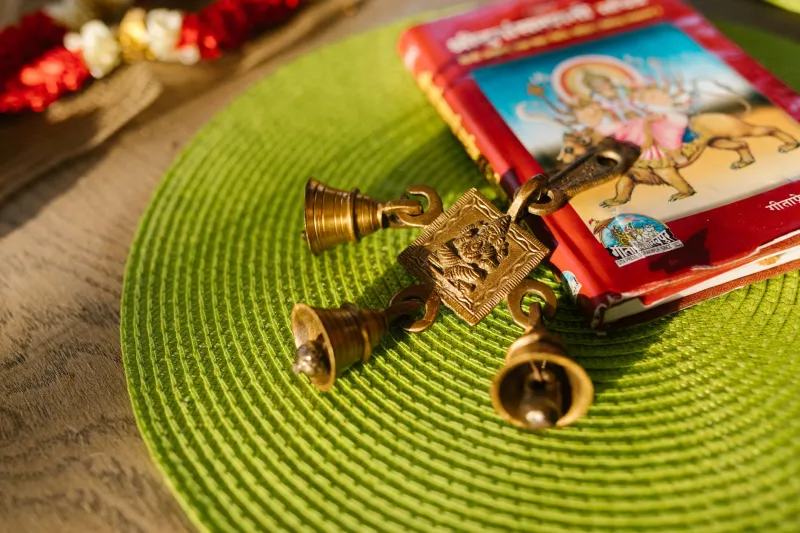
There's also the question of meaning. In traditional Indian homes, design is rarely purely decorative. The brass kalash by the door isn't just a pretty vessel — it has ritual significance. The rangoli pattern at the threshold isn't just a geometric floor design — it's a daily act of welcome, protection, and devotion. The particular arrangement of objects on a puja shelf follows a logic that goes well beyond visual composition.
When these objects migrate into non-desi homes as purely aesthetic choices, the meaning evaporates. Which isn't necessarily a crime — cultures have always borrowed and remixed. But it's worth naming what disappears in the translation, and why that matters to the communities whose traditions are being borrowed from.
Some South Asian designers have found a middle path: working with American clients who are genuinely curious about the why behind the aesthetic, not just the what. Teaching the stories behind the crafts. Connecting clients directly with artisans. Turning the design process into something closer to cultural education than retail therapy.
The Desi Home as Cultural Statement
What's perhaps most interesting about this moment is what it signals about South Asian identity in America more broadly. The Indian American community is no longer a community that feels pressure to minimize its visual presence in American spaces. The brass diyas aren't getting tucked away before guests arrive. The hand-embroidered cushions aren't being swapped out for something more "neutral."
That shift — from concealment to celebration — mirrors what's happening in Indian cinema, music, and food. The culture isn't asking for permission to take up space anymore. It's just taking it.
And if the rest of America wants to follow along, wants to fill their homes with the colors and textures and craftsmanship that South Asian traditions have been producing for thousands of years? Great. Just know what you're bringing into your home. Know who made it, and what it means, and maybe — if you're feeling adventurous — learn the story behind the nani who carried it across an ocean in a suitcase.
That part's not for sale at West Elm. But it's the best part.