Sing the Next Line: Why Antakshari Won't Die (And Why That's a Good Thing)
Ask any Indian kid of a certain generation about antakshari and you'll get the same story: backseat of a Tata Ambassador, mom's arm swinging in rhythm, the whole family screaming the 'm' songs because nobody could think of one starting with 'd.'
Now picture the same game in a dorm basement at the University of Illinois. Or at a post-reception brunch in Edison. Or — and this is real — a team-building session at a Bay Area tech company where a product manager from Pune and a designer from Ohio are somehow both singing Lata Mangeshkar.
The game is back. And honestly, it never really left.
The Rules Are Simple. The Stakes Are Not.
For the uninitiated: antakshari is a song-chain game. One team sings a verse (traditionally starting with 'a'), and when they stop, the other team must pick up with a song beginning with the last syllable sung. Miss, hesitate, or fumble the lyrics, and you lose the round.
That's it. No cards, no board, no app. Just a shared songbook living inside millions of heads.
And that's exactly why it survives. Aarav Menon, a junior at UT Austin who runs a monthly antakshari night through the university's South Asian student alliance, puts it plainly: 'Kahoot requires a laptop and Wi-Fi. Antakshari requires nothing. My roommate who grew up in Delhi and my roommate who grew up in Dallas can play the exact same game.'
Three Generations, One Playlist
Here's the quiet miracle of the game: the Bollywood songbook is effectively frozen in amber. Songs from 1955, 1978, and 2019 all circulate freely in the same canon. Your grandmother knows 'Pyaar Hua Ikrar Hua.' You know it too, probably from her.
That makes antakshari one of the only activities where a 68-year-old and a 19-year-old are equally likely to dominate. There's no skill ceiling of reflexes or trivia arcs — just memory and nerve.
Second-gen hosts say this is the whole appeal. 'My parents are introverts at parties,' says Priya Raghavan, who hosts a league in the Jersey City area. 'But hand them a mic and an 'r' round and suddenly my dad is performing 'Nanha Munna Rahi Hoon' with choreography. I didn't know that man existed.'
From Road Trip to League Play
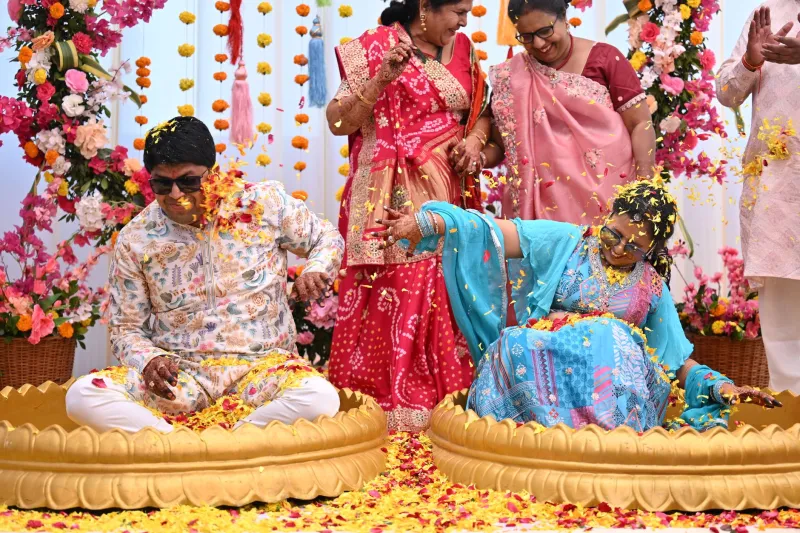
The game has picked up structure along the way. Campus groups have formalized rules — timed responses, themed rounds, Bollywood-only versus playback-singer categories. Some leagues keep score across a semester. A few wedding planners now offer 'antakshari battles' as a sangeet segment, with a hired host keeping both sides of the family trading verses.
Even workplaces have caught on. For diaspora-heavy teams, it doubles as an icebreaker that doesn't feel like an icebreaker. Nobody has to explain their identity in a PowerPoint; they just have to remember what comes after 'm.'
Why It Sticks
Part of it is nostalgia, sure. But part of it is that antakshari solves a real problem for the diaspora: it converts cultural inheritance into something playable. You don't have to explain why Bollywood matters. You just play, and the music does the explaining.
There's also the beautiful humiliation of it. Everyone forgets lyrics under pressure. Everyone blanks on 'd.' The game equalizes — the auntie who's seen 4,000 films and the cousin who's seen twelve are always one bad 'k' away from silence.
And when someone finally lands that perfect deep-cut opener — a Rafi number nobody expected — the room reacts like a buzzer-beater just went in. That's not a game mechanic. That's community.
So the next time you're stuck at a gathering where nobody knows anybody, skip the small talk. Sing something. See what comes back.