First Impressions, Desi Style: How Indian American Families Are Reinventing the Entryway
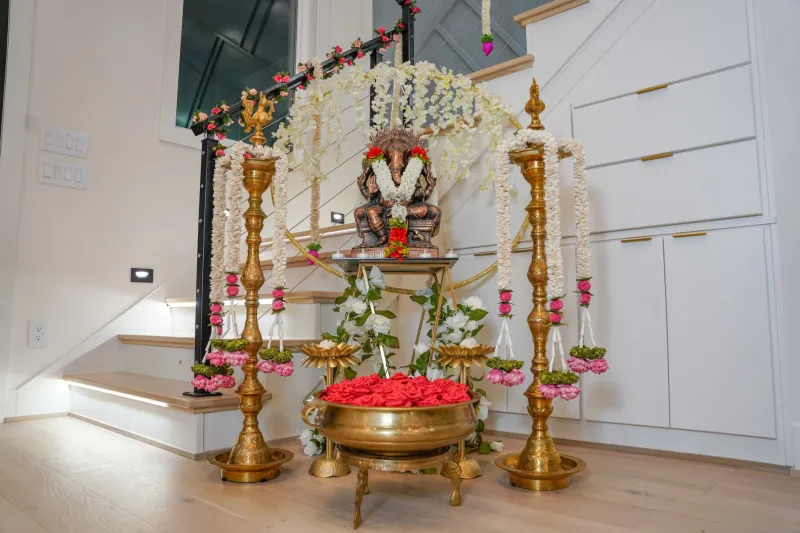
There's a specific kind of pause that happens at the door of a desi home in America. You ring the bell, the door swings open, and before you've even said hello, you've already read the room — or at least the entryway. A small brass Ganesha on a shelf. Rows of chappals lined up with suspicious neatness. Maybe a string of dried marigolds that's seen better days, or a framed calendar from a temple in New Jersey. You know exactly where you are.
For South Asian families who've made the American suburbs their home, the entryway isn't just an architectural afterthought. It's a declaration. And increasingly, it's becoming one of the most thoughtfully designed corners of the desi household.
The Original Problem: American Homes Weren't Built for This
Here's the thing about standard American home design — it really wasn't built with South Asian cultural habits in mind. The classic suburban foyer is often a narrow strip of hardwood flooring with a coat closet and maybe a console table. Functional, sure. But it doesn't account for the deeply ingrained South Asian tradition of removing shoes before entering a home, the near-universal need to display something sacred near the threshold, or the social ritual of greeting guests in a space that feels both welcoming and intentional.
In India, the concept of the dehdleez — the threshold — carries real weight. It's not just where outside becomes inside. It's a liminal space with spiritual significance, often marked with rangoli, a toran (door hanging), or an image of a deity. That meaning doesn't evaporate when a family moves to Naperville or Sugar Land or Fremont. It just has to negotiate with a builder-grade entryway and HOA guidelines.
The result? A fascinating design improvisation that's happening in desi households across the country.
The Shoe Situation Is Actually a Statement
Let's start with the most immediately visible element: the shoes. Any South Asian family will tell you that removing footwear at the door isn't just a cleanliness preference — it's a practice rooted in respect, both for the home and for whatever sacred space exists within it. But most American entryways offer nowhere to put them.
What's emerged is a whole genre of desi shoe storage creativity. Some families invest in beautiful wooden racks that double as decorative furniture. Others use woven baskets that nod to South Asian craft traditions while blending into a more neutral aesthetic. A few have gone full custom — built-in benches with pull-out drawers, designed by contractors who've learned that this particular client group has very specific needs.
But beyond the practical, there's also a social signal being sent. A neat row of shoes outside a front door, or just inside it, tells every arriving guest: we do things a certain way here. It's a quiet but firm assertion of cultural practice in a country where walking inside with your Nikes on is basically the default.
Sacred Corners in Secular Spaces
Walk into almost any traditional Indian home and you'll find something near the entrance that acknowledges the divine — a small idol, a framed image, a lamp that's been lit at dusk since before anyone can remember. Recreating that feeling in an American split-level is both a design challenge and an emotional one.
Some families solve it with a dedicated shelf or niche near the front door, styled like a miniature mandir moment. A small Lakshmi figurine, a diya, a few fresh flowers from the weekend temple visit. Others integrate it more subtly — a piece of traditional tanjore artwork hung at eye level, or a hand-painted madhubani panel that anchors the whole space.
What's interesting is how these choices have started influencing mainstream interior design conversations. The idea of an "intention corner" near the entryway — a small, curated space that sets the spiritual or emotional tone of a home — has been picked up by American lifestyle media, often without full credit to its South Asian origins. But inside desi homes, it was never a trend. It was just Tuesday.
The Gallery Wall Situation
Ask any second-gen South Asian about their parents' entryway and they'll probably mention the photos. The framed wedding portraits. The school pictures going back two decades. The occasional, completely unironic Bollywood calendar or a poster of a film that came out the year the family immigrated.
That visual storytelling is becoming more intentional with each passing generation. Younger South Asian homeowners are curating what amounts to a cultural biography near their front doors — mixing family photographs with framed vintage Bollywood posters, prints of classical Indian miniature paintings, or even digital art from South Asian illustrators they follow on Instagram. It's a foyer gallery that tells you something true about who lives here.
This isn't accidental. It's a response to years of feeling like South Asian identity in America had to be tucked away or explained. The entryway, of all places, is where families are choosing to lead with it instead.
Smell Is Part of the Design
No conversation about a desi entryway is complete without acknowledging the sensory layer that doesn't show up in any design magazine: the smell. Incense, fresh jasmine, the ghost of last night's tadka, maybe a hint of attar from someone's coat. For South Asian visitors, it's immediately comforting — a full-body recognition of home. For non-desi guests, it's often their most vivid memory of the visit.
Some families lean into this deliberately, burning specific incense near the entrance as a kind of olfactory welcome mat. Others are more self-conscious about it, running air purifiers or choosing lighter fragrances that feel less "ethnic" to outside noses. That tension — between pride in cultural identity and anxiety about outside perception — plays out in the entryway as much as anywhere else in the home.
What It All Adds Up To
The desi entryway, when you look at it closely, is a microcosm of the broader South Asian immigrant experience in America. It's a space where two sets of cultural expectations meet and have to figure out how to coexist — where you take your shoes off but still have to fit in with the neighborhood, where you honor your traditions but also live your actual American life.
What's beautiful about it is that families aren't choosing one or the other. They're building something new in that narrow strip of space between the front door and the rest of the house. Something that's unmistakably desi, and unmistakably American, at the same time.
And if you know, you know the moment you cross the threshold.