Reading the Room: How the New Generation of Desi Wedding DJs Became Cultural Translators
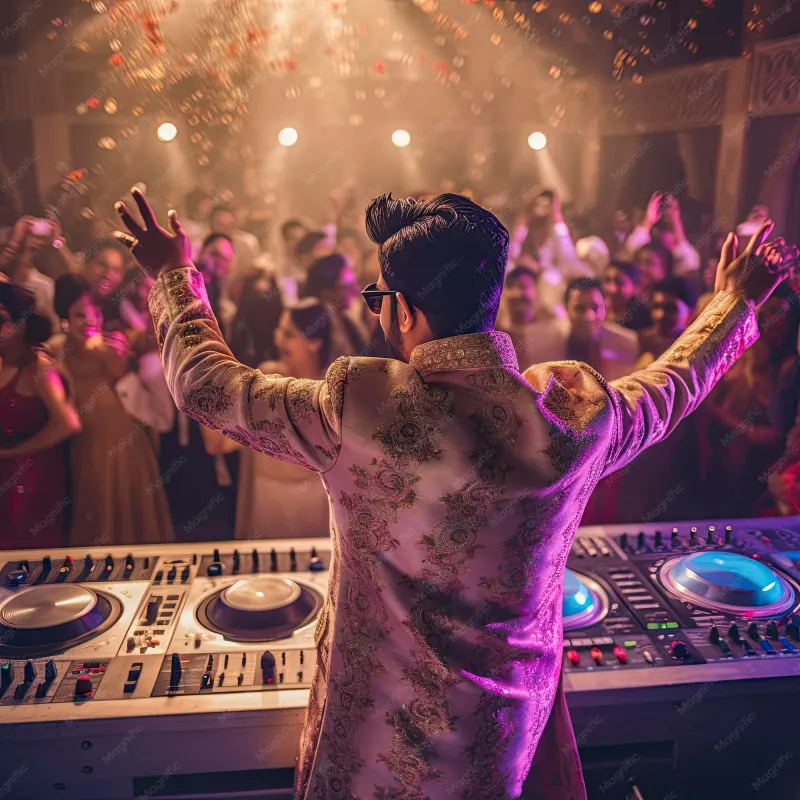
Photo: Indian wedding DJ mixing music dance floor celebration, via cdn.pixabay.com
There's a moment at every South Asian wedding reception in America that the caterers know, the planners know, and the videographers have learned to anticipate. It's the moment the DJ has to decide: do I play the song the bride's mother wants, or the one the groom's college friends will actually dance to?
Get it wrong, and the floor empties like a buffet at the end of the night. Get it right, and you get the viral clip: a sixty-something auntie doing bhangra next to a nineteen-year-old filming a TikTok, both fully committed.
The people who pull this off aren't just DJs anymore. They're archivists, diplomats, and amateur anthropologists rolled into one.
The Sample Is the Bridge
Ask DJs in the New Jersey corridor — Edison, Iselin, the whole stretch of Jersey where wedding season never really ends — and they'll tell you the same thing: the secret weapon isn't a song, it's a sample.
Drop a recognizable Lata Mangeshkar vocal or a Mohammed Rafi hook over a house beat, and you've done something remarkable. You've made a song the older crowd has known for fifty years feel new, and a song the younger crowd has never heard feel inevitable. The elders hear the memory. The kids hear the drop. Nobody has to compromise.
"I'm not playing old songs for the parents," one Jersey-based DJ told us, requesting anonymity because, honestly, the wedding DJ game is competitive. "I'm playing a version of their memory that their kids can't resist. That's the whole job."
The technique has a lineage, of course. Punjabi MC's "Mundian To Bach Ke" proved decades ago that a classic loop over a modern beat could cross every border. What's changed is the volume of traffic. Second-generation DJs now grow up on both sides — streaming their parents' Kishore Kumar records and their own Drake catalogs — so the mashup isn't research. It's autobiography.
Reading a Room Full of Contradictions
The Bay Area crowd, DJs say, presents its own puzzles. Silicon Valley weddings often mean guests flying in from three continents, a couple who met at a tech mixer, and a guest list where the average age swings wildly between the sangeet and the after-party.
"You learn to read shoes," one San Jose DJ laughed. "If the aunties have already switched to their dancing sneakers, you can take a risk. If they're still in the good sandals, you play it safe for another hour."
That risk calculus is real. Play too much Top 40 and the elders retreat to their tables, arms crossed, silently noting the DJ doesn't respect the occasion. Play too much vintage Bollywood and the cousins drift to the bar, phones out, waiting. The skilled ones describe it as a constant negotiation — a set that arcs from R.D. Burman classics during dinner, through a reggaeton-Bollywood hybrid around 10 p.m., into full trap-meets-Punjabi chaos by midnight.
Reggaeton, surprisingly, has become a lingua franca. The dembow rhythm sits naturally next to dhol patterns, and a well-timed Bad Bunny transition after a Punjabi MC track has become the move that proves a DJ knows what they're doing.
The Historian Nobody Hired
What started as party economics — one crowd, one budget, one DJ — has turned into genuine cultural preservation, whether anyone intended it or not.
These DJs maintain libraries that would make a film studies professor jealous: the exact Rafi recording a bride's grandfather danced to in Delhi in 1968, the remix that played at every millennial cousin's sweet sixteen, the sound that's trending on TikTok this week and will be dead by the reception. They field requests like "that song from the Instagram reel, you know the one" and somehow translate them.
And in doing so, they're keeping songs alive that might otherwise fade with each generation. A fifteen-year-old who hears the opening bars of a classic Hindi film melody inside a dance track doesn't experience it as old music. She experiences it as the thing that made everyone scream when the beat dropped. That's not a lesser form of cultural transmission. That might be the only form that works.
The wedding industrial complex gets critiqued plenty — the expense, the choreography, the twelve events. But credit where it's due: the dance floor at an American desi wedding is one of the few places where 1950s Hindi cinema and 2020s trap music actively coexist, and the person making that coexistence work is standing behind a laptop, watching the aunties' shoes.
The next time a DJ seamlessly slides from a golden-era melody into a bass drop and the whole room — every generation, every table — ends up on their feet, remember: that wasn't luck. That was a historian with a subwoofer, doing their job.