Beyond the Arangetram: Why Desi Americans Are Taking Classical Dance Off the Temple Stage
There's a specific kind of Saturday that almost every Indian American kid over a certain age knows by heart. You wake up early. You get your hair oiled and pulled back tighter than feels strictly legal. You put on the ghungroos. You drive forty-five minutes to a community center that smells like agarbatti and sambar. You perform. Your relatives take a hundred photos. Someone's uncle says you looked "just like a real dancer." And then, somewhere in your late teens, you quietly stop going to class.
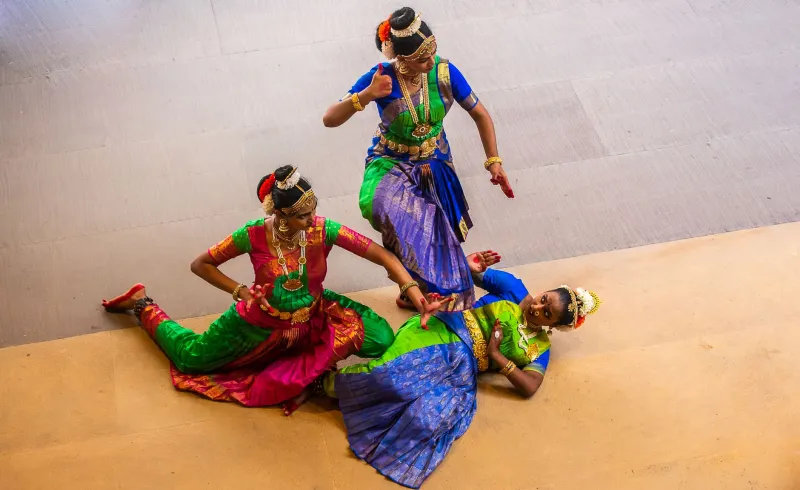
For a long time, that was the full arc of classical Indian dance in the diaspora — a childhood ritual that faded before it ever became a real artistic identity. But something has shifted. Across the country, a new wave of South Asian American performers is refusing to let Bharatanatyam, Kathak, and Kathakali become relics of the recital circuit. They're taking these forms somewhere entirely different: contemporary art galleries, hip-hop stages, short-form video, and experimental theater. And they're forcing a long-overdue conversation about what preservation actually means.
The Recital Trap
Let's be honest about what the traditional model looked like. Classical Indian dance in America has historically been organized around a specific cultural logic — keep the form intact, pass it down, perform it for the community. That's not nothing. Gurus who immigrated in the '70s and '80s did genuinely heroic work keeping these traditions alive in cities that had no infrastructure for them. The arangetram — a student's formal debut performance — became a cornerstone event in Indian American social life, a kind of bat mitzvah with mudras.
But the model had a ceiling. Dance stayed inside the community. It rarely crossed over into mainstream American arts spaces. And for many second-generation dancers, the gap between the rigorous, devotional art form they were training in and the way it was actually being presented — as a cultural show-and-tell — started to feel like a contradiction.
"I trained for twelve years," says Priya Venkataraman, a Bharatanatyam dancer based in the Bay Area who now performs at venues like YBCA and collaborates with jazz musicians. "And for most of that time, I was performing for audiences who already knew what I was doing. I wanted to make work that could talk to people who had never seen this before — and I wanted it to hit them the same way it hits me."
New Stages, New Stakes
What's happening now is less a rebellion against tradition and more a renegotiation of its terms. Dancers like Venkataraman aren't abandoning the technical vocabulary they spent years building — the precision of adavus, the grammar of abhinaya, the sheer physical demand of Kathak's footwork. They're deploying that vocabulary in new contexts and asking new questions with it.
In New York, collectives like Nritya Collective and individual artists such as Rachna Nivas have been staging Bharatanatyam in settings that would have seemed unthinkable a generation ago — immersive gallery installations, collaborations with electronic composers, performances that sit comfortably alongside contemporary dance without apologizing for being something different. In Chicago, Kathak practitioners are working with spoken word artists. In Houston, a group of dancers is using Instagram Reels to break down the storytelling logic of a single abhinaya sequence, racking up hundreds of thousands of views from people who have never set foot in a classical dance performance.
That last part matters more than it might seem. The digital piece isn't just marketing — it's a genuine artistic strategy. When a dancer posts a sixty-second clip explaining the emotional layers inside a single hand gesture, she's not dumbing it down. She's making an argument that this art form is worth your attention, and she's making it in the language her generation actually speaks.
The Authenticity Argument
Not everyone is thrilled. The pushback from within the classical dance community is real, and it's worth taking seriously rather than dismissing as gatekeeping. Some senior gurus and practitioners worry that fusion work strips the devotional and philosophical context that gives these forms their meaning — that a Bharatanatyam piece performed to a Kendrick Lamar track is a novelty act, not a living tradition.
It's a fair tension. Bharatanatyam is a devotional art with roots in temple ritual. Kathakali is a complete theatrical system with its own cosmology. These aren't just movement styles you can swap in and out of different containers without losing something.
But the dancers doing this work are, for the most part, deeply aware of that. Many of them have trained for longer and more rigorously than their critics assume. The question they're asking isn't "does tradition matter?" It's "who gets to decide when innovation crosses a line, and by what authority?"
"Every classical form has evolved," points out dancer and choreographer Sanjay Murthy, who teaches Kathak in Atlanta and has collaborated with contemporary dance companies. "Kathak itself absorbed Mughal court influences. Bharatanatyam as we know it was partly reconstructed in the 20th century. The idea that there's a frozen, pure version we have to protect — that's a myth. The question is whether you're doing the work with understanding and respect."
Gen Z Is Watching
Maybe the most interesting audience for all of this is the generation that grew up watching their older siblings quit dance class. For many Gen-Z Desis, classical Indian dance has felt like something that belonged to their parents' idea of cultural maintenance — important in theory, slightly embarrassing in practice. The new wave of performance work is changing that.
When a dancer codes her performance through the visual language of social media without losing the technical depth underneath, she's creating an entry point that didn't exist before. Young South Asian Americans who would never go to a formal recital are watching, sharing, commenting. Some of them are signing up for classes for the first time in years.
That might be the most radical thing happening here — not the fusion performances or the gallery shows, but the simple fact that classical Indian dance is becoming something a twenty-two-year-old in Columbus, Ohio might actually want to engage with on her own terms.
The arangetram isn't going anywhere. But it's no longer the end of the story. It might finally be becoming the beginning.