After Midnight, Before the World Wakes: How Desi Americans Are Turning Movie Night Into Something Sacred

Somewhere in the suburbs of Atlanta, a family of five turns off every light in the house except the glow of the projector. The kids are older now — old enough to sit still, old enough to feel things. The mother has queued up Mughal-E-Azam. The father has made chai. Nobody is scrolling. Nobody is talking. And somewhere between Madhubala's first scene and the film's devastating final act, something shifts in the room. It stops being a movie. It starts being something else entirely.
This is happening more than you think.
Across the United States — in living rooms in Fremont, in finished basements in New Jersey, in apartments in Chicago's Wicker Park — South Asian Americans are reaching for cinema the way their grandparents reached for prayer. Not casually, not accidentally, but with the kind of deliberate attention that transforms an ordinary act into a ritual.
When Storytelling Was Always Sacred
To understand why this feels so natural to desi families, you have to go back further than Bollywood. Way further.
In ancient India, storytelling was never just entertainment. The Katha tradition — oral narratives passed down through generations — carried moral weight, cosmological meaning, and emotional instruction all at once. Performances of the Ramayana in village squares weren't just cultural events; they were communal acts of devotion. You watched, you wept, you understood something about yourself that you couldn't have reached alone.
Cinema, when it arrived in India in the early twentieth century, inherited all of that. The song sequences that Western critics sometimes dismiss as interruptions are, for South Asian audiences, closer to bhajan — devotional hymns meant to slow you down and open you up. The larger-than-life heroes aren't just characters; they're almost mythological archetypes. Indian cinema has always been doing something more than telling stories. It's been doing what temples do: creating a space where the ordinary world falls away.
So when desi Americans in 2024 start treating movie night like a spiritual practice, they're not inventing something new. They're remembering something old.
The Ritual Takes Shape
What does a sacred movie night actually look like? It varies by family, by generation, by region of origin — but there are patterns.
For some households, it starts with curation. Not algorithm-driven "you might also like" suggestions, but genuine, deliberate selection. Films chosen for their resonance: Deewar, Guide, Pather Panchali, Bahubali, 96, Kumbalangi Nights. The selection process itself becomes part of the ritual — a conversation about what the family needs right now, what question they're sitting with, what kind of film might meet them there.
For others, it's about environment. Phones go face-down or into another room entirely. The snacks are homemade, not delivered. Someone lights incense — not performatively, just because it feels right. The room is arranged so that everyone is facing the screen, together, the way you'd face an altar.
And then there's the talking. Not during the film, but after. Long, unhurried conversations that run past midnight. About what a character did and why. About what the film reminded them of. About their own lives, their own choices, their own grief. The movie becomes a doorway, and what's on the other side is something that doesn't have a name but feels important.
"We used to watch films together when I was growing up in Hyderabad," says one woman in her forties, now living outside Houston. "But here, there's no neighborhood, no community dropping by. So the film has to carry more weight. It has to be the thing that brings us into the same room and makes us feel connected — to each other, to where we came from, to something bigger."
The Films That Feed Something
Not every film works for this purpose, and desi cinephiles are increasingly articulate about the difference. There's a distinction being drawn — sometimes explicitly, sometimes just felt — between films that entertain and films that nourish.
Spiritual cinema, in this context, doesn't necessarily mean religious cinema. It's not limited to films about gods or temples or devotional themes, though those certainly qualify. It's more about films that take human experience seriously. Films that sit with complexity rather than resolving it cheaply. Films that trust the audience to feel something without being told what to feel.
Tamil cinema has become a particular touchstone for this kind of viewing. Directors like Mani Ratnam and Vetrimaaran have built bodies of work that operate on multiple registers simultaneously — emotionally immediate and philosophically rich. Malayalam cinema's recent renaissance, with films like The Great Indian Kitchen and Jallikattu, has attracted viewers specifically because of how seriously those films treat ordinary life. Even certain Bollywood films from the seventies and eighties — the era of Gulzar, of Shyam Benegal, of films that weren't afraid to be slow — are being rediscovered by younger desi Americans hungry for something with more soul.
Streaming has made all of this more accessible, which is part of why the practice is growing. But the technology is just the delivery mechanism. What's driving it is something harder to quantify: a community in the middle of a long negotiation with itself about identity, belonging, and meaning, reaching for the art form that has always carried those negotiations best.
The Temple That Fits in Your Living Room
There's something worth sitting with here, which is how much this mirrors the function of religious community — and how consciously some families are drawing that parallel.
For South Asian Americans who live far from a strong desi community, who don't have a mandir nearby or a diasporic neighborhood to wander into, the cultural and spiritual anchors of their heritage can feel genuinely distant. Movie night, done with intention, fills some of that gap. It creates a container for the kind of collective feeling that humans need — the sense of being moved together, of sharing an experience that's larger than any individual.
The late hour matters, too. After midnight, the world gets quieter. The defensive layers people carry through the day start to soften. Children who are too cool to talk to their parents at dinner will, it turns out, cry at the same scene and then want to talk about it. There's something about darkness and a shared screen that lowers the usual barriers.
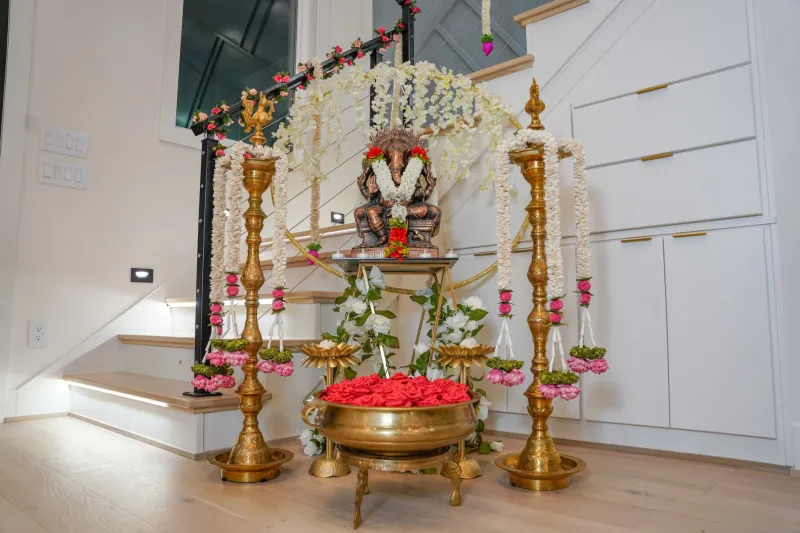
PrabhuGhar — prabhu meaning lord, ghar meaning home — is built on the idea that South Asian culture lives in the domestic space, in the everyday practices that carry meaning forward. This is one of those practices. Quiet, unannounced, happening in living rooms across America. A community that was raised on the idea that stories are sacred is finding, in the middle of their very American lives, that they still believe it.
The credits roll. The lights come up slowly. Someone makes more chai. And for a little while, in a house in the suburbs, the world feels a little more legible than it did before.