Reel Life, Real Rooms: How Desi Families Are Turning Basements Into Bollywood Sanctuaries

Somewhere in a New Jersey suburb, behind a door that probably used to lead to a storage room full of pressure cookers and old suitcases, there is now a 120-inch projection screen, a sound system that makes the neighbors nervous, and a snack bar stocked with Haldiram's Bhujia and a popcorn machine that gets more use than any appliance in the kitchen. This is not a coincidence. This is a movement.
Indian American families — from the Bay Area to the DMV corridor, from Chicago's northwest suburbs to the Katy exurbs outside Houston — are investing serious money and serious thought into dedicated home cinema spaces. Not just a big TV in the living room. Not just a decent soundbar. We're talking purpose-built rooms with theater seating, acoustic panels, custom lighting, and, yes, aesthetics that feel unmistakably, intentionally desi.
From Streaming Fatigue to Spatial Commitment
The pandemic cracked something open in a lot of households. When movie theaters shut down and streaming became the only option, families discovered both the joy and the frustration of watching films at home. The joy was obvious — no parking, no overpriced tickets, no explaining to the aunties why you're crying at a random Shah Rukh Khan scene. The frustration was subtler: the couch wasn't quite right, the sound kept waking up the kids, someone was always on their phone, and the experience never quite matched the gravity of what was on screen.
For South Asian families specifically, that frustration had an extra layer. Bollywood films — the big ones, the ones that feel like events — are not designed for distracted viewing on a laptop. Baahubali was not meant to be watched on a 55-inch TV with the volume turned down because someone has a Zoom call in the other room. These are immersive, maximalist, emotionally enormous films. They deserve a room that takes them seriously.
That realization pushed a lot of families toward a question they hadn't seriously asked before: what if we just built the thing?
The Room Itself Is the Statement
What makes the desi home theater trend distinct from the general American home improvement craze isn't the gear — it's the intention behind it. When a South Asian family builds a screening room, they're not just upgrading their entertainment setup. They're carving out a physical space that says: this culture matters here, in this house, in this country.
That framing shows up in the design choices. Walk into enough of these rooms and you'll notice recurring motifs. Warm lighting that echoes the amber glow of old cinema halls in Mumbai or Chennai. Framed vintage Bollywood posters — not the generic ones you find on Amazon, but actual prints sourced from collectors or shipped from back home. Fabric choices that lean into rich jewel tones: deep teals, saffron oranges, burgundies that feel like a salwar kameez you'd wear to a wedding.
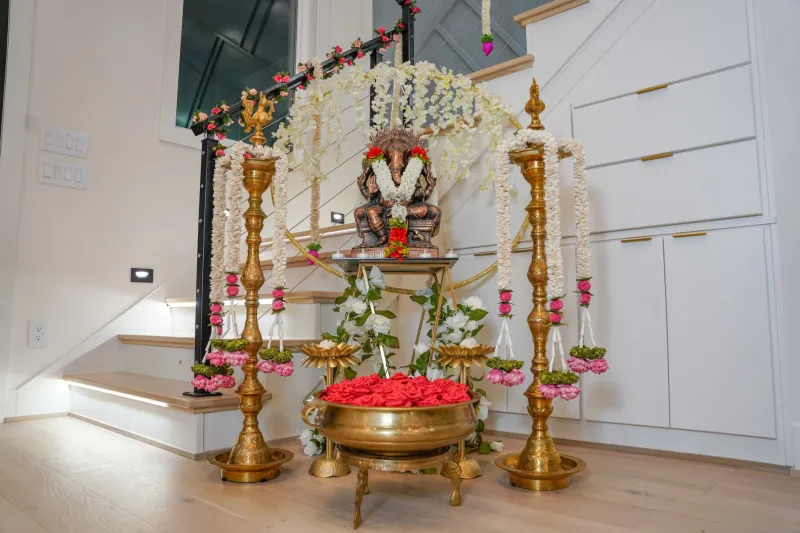
Some families go further. Custom cushions embroidered with film titles. A small shelf near the entrance holding a brass Ganesha figurine — because you don't start anything important without asking for blessings, including a movie night. Snack stations that function less like a concession stand and more like a curated expression of regional identity: Kerala mixture next to Gujarati chakli next to a jar of jeera cookies someone's mom sent from back home.
This is interior design as cultural autobiography.
The Technology Is Just the Beginning
On the hardware side, the setups vary wildly depending on budget and ambition. Entry-level rooms might feature a quality 4K projector, a basic surround sound system, and blackout curtains — a few thousand dollars total, manageable for a family that's been saving up. At the higher end, families are hiring home theater consultants, commissioning custom millwork, and installing Dolby Atmos systems that cost more than some used cars.
But the technology conversation within desi households tends to take a specific shape. It's not just about specs — it's about what the specs enable. A good sound system means you can actually hear the difference between a Lata Mangeshkar recording and a modern remix. A high-brightness projector means the colors in a Sanjay Leela Bhansali film land the way the director intended. These families aren't just buying equipment; they're buying fidelity to an art form they love.
Streaming services have made this easier and more complicated at the same time. Platforms like Netflix, Amazon Prime Video, and Zee5 have brought an enormous catalog of South Asian content into American living rooms — but they've also made it painfully clear how different that content looks when watched in the right conditions versus the wrong ones. Once you've seen RRR on a proper setup, you cannot un-see it.
It's a Family Thing — and That's the Whole Point
Ask anyone who's built one of these rooms why they did it, and the answer almost always circles back to family. Not just the nuclear family under one roof, but the extended web of relatives who show up on weekends, the cousins visiting from out of town, the grandparents who flew in for a few months and need something to do on Tuesday afternoons.
For South Asian households, communal film watching has always been a social ritual. Back in India, going to the cinema was an event — you dressed up, you bought snacks, you argued about the film for days afterward. In America, that ritual lost some of its infrastructure. Multiplexes don't always screen the films you care about. When they do, the experience of watching a Telugu film surrounded by people who don't share the cultural context can feel isolating in ways that are hard to articulate.
The home theater solves that. It creates a space where the cultural context is built into the room itself. Where grandma can watch her serials without anyone sighing. Where the kids can grow up understanding that Indian cinema is not a niche interest but a full-blown cinematic tradition worthy of the same reverence as anything Hollywood produces.
Building Prabhu's House, One Room at a Time
There's something almost devotional about the care these families put into these spaces. A room designed to honor stories — to give them the acoustic richness, the visual scale, and the communal warmth they deserve — is not so different from any other sacred space in a desi household. It's a place where something important happens, where the family gathers, where culture gets transmitted from one generation to the next.
And in a country where South Asian families have spent decades adapting, code-switching, and finding workarounds just to feel at home, building a room that doesn't require any of that feels like a quiet but powerful act of arrival.
The projector hums. The lights dim. Someone hands you a bowl of Bhujia. On the screen, the opening notes of something enormous begin to play.
You're home.